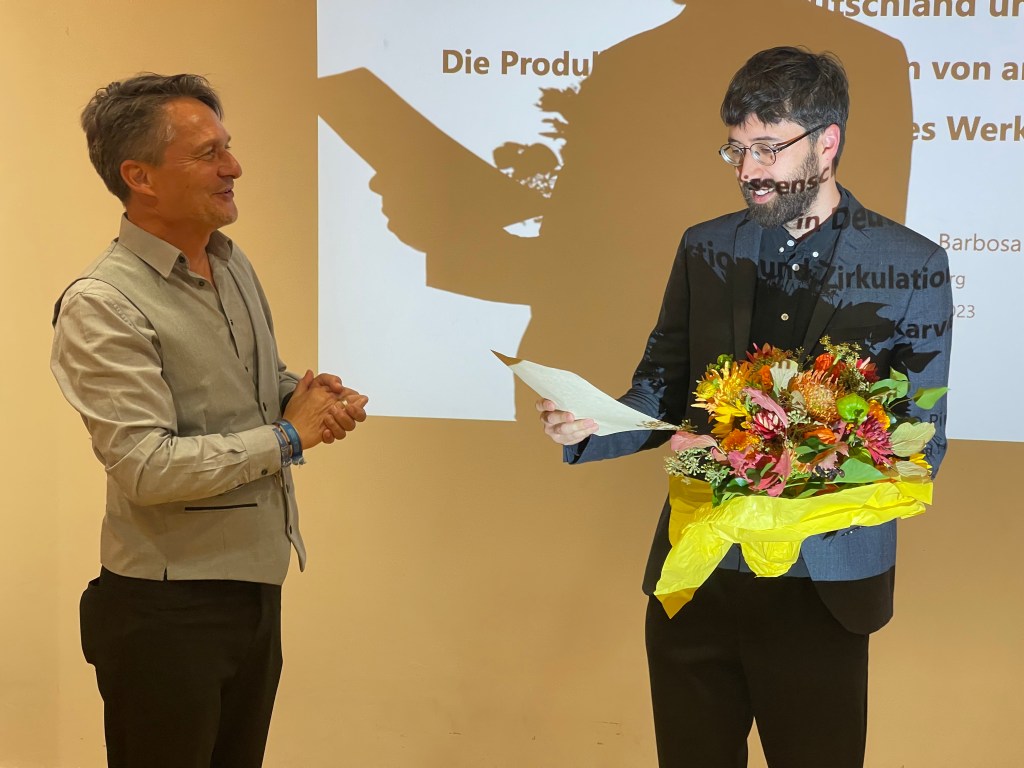
An interview with Thiago Pinto Barbosa, recipient of the 2023 Prize of the German Historical Institute London and the Frobenius research promotion award 2023
Dr. Thiago Pinto Barbosa was awarded with the 2023 Prize of the German Historical Institute London and the Frobenius research promotion award 2023 for his dissertation titled “Science and Human Difference in Germany and India: The Production and Circulation of Anthropological Knowledge in Irawati Karve’s Work and Legacy”.
The dissertation connects recent debates in the history of social and cultural anthropology with archival material and data gathered during field work on the Indian anthropologist Irawati Karve as well as on the legacy of her work. We celebrate these prestigious recognitions with an interview in which Thiago discusses the main themes and arguments animating his research and how they relate to the broader topic of the anthropology of global inequalities and the work carried out by the group.
Dear Thiago, what brought you to the topic of your dissertation and to develop an interest in the work and life of Irawati Karve?
When I was a student at the Freie Universität Berlin, I organized an exhibition about the history of a university building that from 1927 until 1945 used to be the Kaiser Wilhelm Institute for Anthropology, Human Heredity, and Eugenics (KWI-A). The institute was a well-established center for research on racial hygiene and, during the Nazi regime, had a very close connection to the formulation of eugenicist policies. My archival research for the first exhibition about its history, Manufacturing Race, surprisingly revealed that other non-European students came there to research—from Korea, China, Venezuela, and India, one of them being Irawati Karve (1905–1970).
I wondered: Did these non-European students see and defy the racist bias of their professors, adapt racial theories, or conform to them? In part because I was a foreign student in Berlin myself and was confronted with so much Eurocentric bias in the (political science) theories I was being taught, these questions motivated my research.
Karve, in fact, was a quite special case: in her PhD in Berlin, she researched about skull asymmetry (a trait which was believed by some to be more protuberant in white European skulls due to a biological component of “civilization”). But she reached a conclusion that defy the racist theories of that time and place: she affirmed that she could not observe a correlation between “race” and skull asymmetry. She then suggested that this shape of the skull was rather a product of the environment, not a biological or racial condition.
The fact that Karve’s research stood out as anti-racist in that particular institute made me want to know more about her and her work. After she went back to India (where she became one of the country’s most famous anthropologists), however, she also adapted racial theories and methods to study ethnic, caste, and religious groups. Karve played an important role in the biologization and racialization of the understanding of these social group categories in India. At the same time, she was also in dialogue with important discussions about “race” in science, which gained more critical resonance in the post-World War II context. My research tried to account for how Karve changed her perspectives on “race” and tried to distance herself from scientific racism, and I also examined how her work has been influential to anthropology and population genetics research today. In sum, I wanted to contribute to tackle the problem of the current legacy of racism in science. I was moved by the questions of how the sciences that study human diversity could be different and how they could overcome the imprint of scientific racism.
What are the core arguments and thesis elaborated in the dissertation and which kind of contribution do you see your dissertation making in the larger discussion on science and racism in contemporary anthropological debates?
My main historical thesis was that Karve’s knowledge output and legacy—as well as that of other Indian scientists who were also trained at the KWI-A—have injected a major impulse to the racialization of the understanding of caste and ethnicity in India, contributing to a biological rigidization of these difference categories. This thesis expands our understanding of the impact of German racial sciences: it did not stop at the European borders. In fact, it played a role in the racialization of human difference in India and elsewhere.
Regarding my contribution to discussions about science and racism today, one of my main theses has implications for anthropology and human biological sciences. The more I studied these sciences of human diversity, the more it became clear that paying attention to the realm of inequalities is needed. My thesis supported the view that human diversity can be better understood if research also attends to inequalities that shape human existence. I underline the importance of attuning to inequity and injustice, not only because racism and casteism shape biological differentiations but also because both cultural and biological essentializations in science can work in racializing ways.
In addition, thinking with the case of Karve, I have put forward an argument for the need to reconsider the relationship of politics and science as entangled, and to think of response-ability and justice as an ethical orientation that allows the construction of worlds with more equity. If the lead scientists working at the KWI-A in Germany were prevented from reflecting about political consequences of their work also because of their positivist idea of science, I argued that the same limitation can be seen in many population geneticists today, for example. Scientists that study human diversity could profit a lot from a more sustained engagement with the multifaceted ways in which their sciences and the social world in which they are embedded co-constitute each other.
Further, on a more meta-level, a key theoretical-methodological contribution of my thesis has been to add the dimension of historicity to material semiotic and ethnographic studies of science. I put forward an argument for the importance of expanding our ethnographic and phenomenological attention to the past when we study science. Following the backstories of technological materials used in science brought to light how racial theories and methods travel through time and space and make themselves present, in vivid and ghostly ways. Thus, paying attention to the historicity of these objects, from the ideas that shaped their design to their circulation, is especially important when dealing with the current legacy of coloniality and racism in science.
How does your research relate to the broader framework of anthropological knowledge on global inequalities?
My work relates to the topic of inequalities in different ways. Essentially, “race” is a category of difference and scientific concept that truly has had a global reach as it is entangled with the history of colonialism and globalization. In a way, biologizing approaches of reading human diversity through “race” have often concealed the dimension of global socioeconomic inequalities that also accounts for variation among humans. In addition, on a practical level of how science works, I have also argued that global inequalities shape science in significant ways. One could think that it is due to global inequalities that Karve, for example, was dependent on getting an education in Europe if she was to succeed as an anthropologist. In my ethnographic observations of current research, I have also observed that global material inequalities not only structure international scientific dependencies but also limit scientific sovereignty and shape knowledge outcomes. Attending to this problem of global material inequalities in science will be important as we push further the conversation on decolonizing sciences.
After such an accomplishment, what’s next for you and your dissertation?
I am currently harvesting, or working on, different fruits of this dissertation: a biography of Irawati Karve (which I wrote together with her granddaughter and fiction writer Urmilla Deshpande), an article on the idea of the “Aryan race” in population genetics of India, and another article on how scientific racism has an imprint in methods and instruments of anthropometry (the methodology of measuring and classifying human body parts and bones). In the near future, I want to develop a project in which I will reflect about other anthropological categorizations of difference, this time in Brazil.
 ANTHROPOLOGY OF GLOBAL INEQUALITIES
Leave a comment