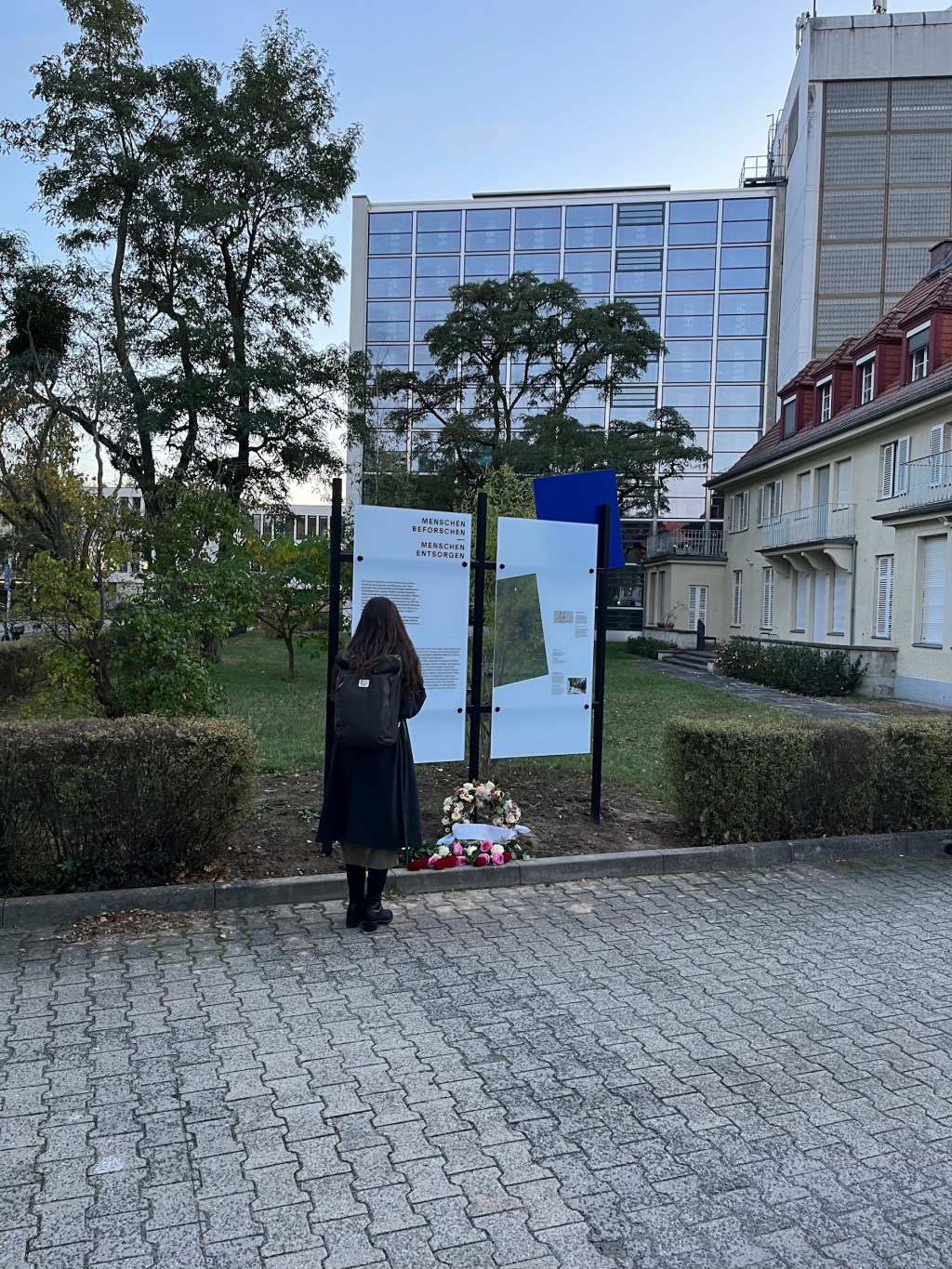
Flowers were placed next to a stele in the opening of the Ihnestraße Memorial Site’s exhibition “History of Science and Injustice”, October 2024 (Photo by the author)
by Thiago P. Barbosa
The beautiful three-story building at oak-shaded Ihnestraße 22 gives little indication of its dark history. Now home to the political science department of the Freie Universität Berlin, the only visible reminder of the building’s past was a weathered plaque. Dated 1988, its metallic inscription, blurred by the effects of time and weather, can only be deciphered by the most determined readers. The plaque informs attentive visitors that this building once housed the Kaiser Wilhelm Institute of Anthropology, Human Heredity, and Eugenics (KWI-A). From 1927 to 1945, it was a center for racist and eugenicist research that actively supported Nazi policies of so-called racial hygiene. The brief text also notes that Josef Mengele, the infamous medical researcher stationed at Auschwitz, was directly supervised by Otmar Freiherr von Verschuer, an expert in twin studies and one of the institute’s directors. The plaque concludes with a pointed reminder of the responsibility scientists bear for the knowledge they create.
In 2013, struck by the lack of visibility and remembrance surrounding this history, a group of students, including me, organized the first exhibition about the KWI-A. In complementation to the part of the history remembered by the plaque, this exhibition also also addressed the institute’s pre-Nazi era, including the history of its founding director, Eugen Fischer, and his close entanglement with German colonialism. The German biological anthropologist’s career began with racial research on colonial subjects in the former German colony of South West Africa, now Namibia. Entitled “Manufacturing Race”, the exhibition project turned into a website, which provided a platform for younger generations of students to continue remembering this dark history—and to continue the plea for an adequate institutional response to it.
October 2024 marked a major milestone in efforts to commemorate the history of eugenics on the Freie Universität Berlin campus: the inauguration of the permanent exhibition and memorial at Ihnestraße 22. Led by historian Manuela Bauche and her team, this project was both a response to student activism advocating for institutional memory and the product of Bauche’s committed historical research and participatory approach to memorialization. Over three years, Bauche and her team facilitated a collaborative process involving two advisory boards: one comprising scholars with expertise in scientific racism, antisemitism, and eugenics, and another representing societal organizations and groups historically victimized by the KWI-A’s research. These included the Herero in Namibia, Jews, Roma and Sinti, disabled persons, and other groups affected by racism.
As a former student activist involved in the earlier exhibition, I was invited to join the advisory board. Throughout several meetings, we discussed and contributed to the content and format of the memorial and exhibition. Contrary to expectations that such diverse groups might face insurmountable disagreements, the discussions were remarkably productive, yielding rich insights. At a time when reactionary forces often pit minorities against each other, this truly co-productive approach demonstrated the potential for dialogue and solidarity in addressing historical injustices. Not only it affirmed that cooperation among groups affected by racism, antisemitism, and ableism is possible. It also showed the benefits of connecting and commemorating histories of both German colonialism and National Socialism. The memorial at Ihnestraße 22 exemplifies the generative potential of what Michael Rothberg terms a “multidirectional memory” approach to histories of injustice.
The memorial’s inauguration included a collective walk through its decentralized exhibition, titled “A History of Science and Injustice”. The walk began with a moment of remembrance for those whose remains were discovered in the ground near the building. Participants placed flowers at an outdoor stele commemorating the recent discovery of thousands of human and animal bone fragments on the site (see picture above). The KWI-A not only conducted genetic and medical research on humans and animals but also maintained an extensive collection of human skulls and other remains, many acquired from colonized territories. Some of these remains were likely discarded or concealed in the surrounding soil.
The exhibition features several steles around and inside the building, besides having an extended version online. Outside the building, one of the steles provides information about the institute’s directors, positioned so that readers look out onto the villa of one director through a transparent window. Others detail the institute’s eugenicist research and its ongoing relevance, given how eugenicist thinking continues to influence ideas about which lives or bodies are worth living. Inside the building, exhibits are distributed across various floors, including the basement, where medical research took place, and the attic, which once housed the bone collection. These exhibition elements evoke the building’s historical functions. For example, an exhibition panel near the main lecture hall recounts the KWI-A-led courses that were once held there.

Introductory stele at the entrance of Ihnestraße 22 (Photo by the author)
Through a mix of texts, images, and video interviews with experts, the exhibition explores the KWI-A’s conception of biological and physical anthropology, grounded in racist premises. Importantly, it also highlights the human impact of this research, focusing on the stories of those directly affected by it. This emphasis emerged from the participatory process behind the exhibition, as many on the advisory board stressed the importance of centering the experiences of victims alongside those of the perpetrators.
The result of this careful participatory approach and historical research is an exhibition that looks at the issue of eugenics and scientific racism from different angles, highlighting the complexity and multitude of implications of the knowledge produced at Ihnestraße. Situated in a building where teaching and research continue, the Memorial serves as a powerful reminder of the ethical responsibilities inherent in all scientific endeavors. We can hope that the Memorial can be a place to educate on the issues it remembers, as well as to commemorate and mourn for the lives lost or harmed by scientific racism.
 ANTHROPOLOGY OF GLOBAL INEQUALITIES
Leave a comment