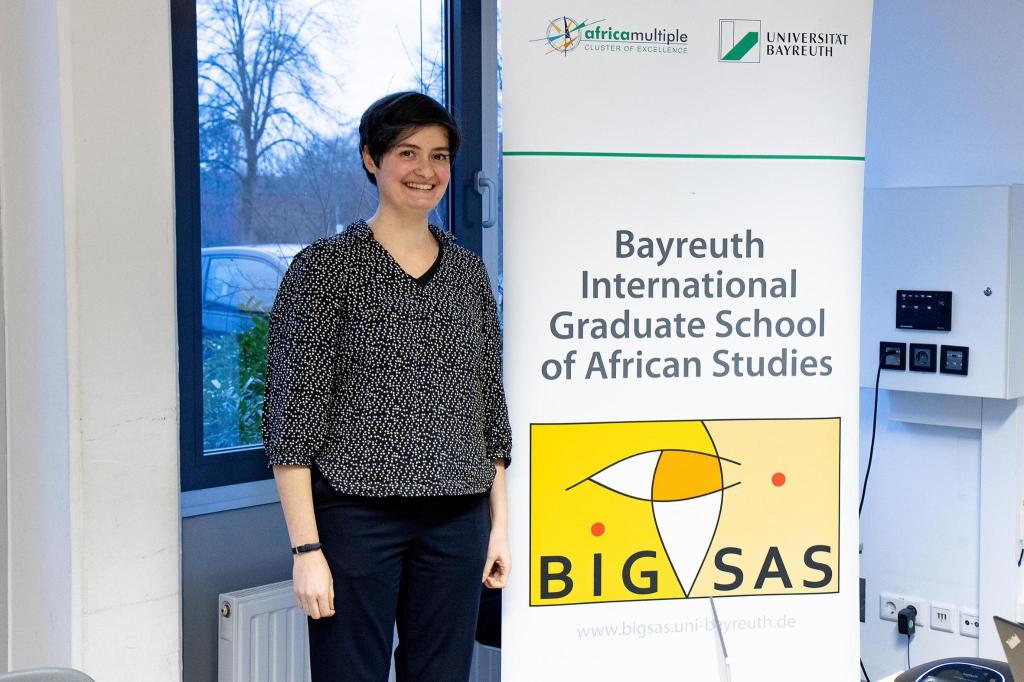
On the 18th of January, our group member Eleanor Schaumann has brilliantly defended her dissertation supervised by Katharina Schramm, becoming the 200th graduate of the Bayreuth International Graduate School of African Studies (BIGSAS).
Dear Eleanor, your dissertation developed from the broader project “Karakul circulations” of the Africa Multiple Cluster of Excellence at the University of Bayreuth: how your work relates to it and how did you develop an interest in the Namibian Karakul industry?
It all started with sheep. My initial point of entry came from my previous work on the political ecology of sheep farming in North Frisia, on which I wrote my master thesis. Namibian Karakul farming combines two topics I have long been interested in, agriculture and colonial history. The “Karakul Circulations” project and the Africa Multiple Cluster in general were great academic contexts to think the entanglements of violent history, knowledges, ecologies and values not as separate spheres but in relation to each other. While my work is primarily grounded in the current situation of Namibian Karakul, or Swakara farming, the wider research project was more concerned with the circulations of knowledges, people, animals, and wealth. A special focus was on the Namibian-German history and present.
What are the core arguments and thesis elaborated in the dissertation and which kind of contribution do you see your dissertation making in the larger discussion within the anthropological discipline on value and valuation practices and their entanglement with colonial histories?
I argue that there is a multiplicity of values, an ecology of values at work in Karakul farming. When pelt prices collapsed and Karakul farming fell into crisis, this not only affected people’s income, but their identities. Farmers experienced a dissonance of the value they perceived their products and their way of life to have and the actual market prices they received. When economic value become unreliable, other values were mobilised by people to make sense of what they were doing. This particularly affected white commercial farmers, the descendants of colonial settlers. Their legitimacy of land ownership was tied to their identities as economically successful farmers. When economic success through farming became near impossible, they stopped measuring themselves by it. Instead, there was a shift to narratives of custodianship, caring for the land and the species inhabiting it.
There has recently been quite an upturn in work and value(s) and valuation studies, particularly in relation to agriculture. I think that value theory is a really useful analytic framework to make sense of why people farm, even when there is little money in farming. My work builds on classic anthropological value literature, as well as on the work of scholars of valuation studies, who look at how value is done. One contribution of my thesis is to put these bodies of work into more explicit conversation. I argue for an ecology of values, not a taxonomy of distinct value types. The community-building and meaning-making versions of value do not stand in opposition to economic values. Even when an industry and a product is as commodified as Karakul sheep farming, economic value alone does not explain farmers activities and motivations. However, at least in the long-term, the Karakul farming community will have a difficult time in maintaining itself without some degree of economic value generation.
How does your research relate to the broader framework of anthropological knowledge on global inequalities?
My research topic is steeped in ongoing issues of colonial inequalities, racialisations and the unequal distribution of land and wealth. Most of the wealth and land among my research participants is concentrated in the hands of white farmers, who inherited large farms and large sums of money accumulated under the apartheid regime and German colonialism in Namibia. And yet, even wealthy farmers have a hard time living off farming. One of the things that makes value(s) and valuations such an interesting analytic framework is that it allows us to follow the circulations of wealth across time and space and across institutional scales. In the case of Karakul farming, there was a shift in the ways that wealth and inequalities are articulated. While Karakul farming was formerly a way (for white commercial farmers) to become wealthy, farmers now need wealth in order to keep farming.
After such an accomplishment, what’s next for you and your dissertation?
For the time being, I am far from done with this topic. I have plans for at least two more articles and hope to publish my thesis as a book. I am thinking about future project ideas around agriculture and the multiplicities of values and identities in the European context. Amidst ecological and economic crises of agriculture, I feel like this is a topic of considerable urgency.
 ANTHROPOLOGY OF GLOBAL INEQUALITIES
Leave a comment